Labour day brings us a Monday of work off and an excuse to either blob and do nothing for an extra day or to jam pack our weekend full of all of the things that we wish we had time to do but generally don't.
My fiancee Shellie and I chose the latter.
We like being busy creating things or going on adventures throughout our city and country. We decided Saturday we would wake up early and get straight to work in making a vegetable garden.
The basis of the garden; old pallet timber
We salvaged the old pieces of pallet timber from around the property to construct a box that would provide the basis of our garden.
Take note ladies, you too can get stuck in.
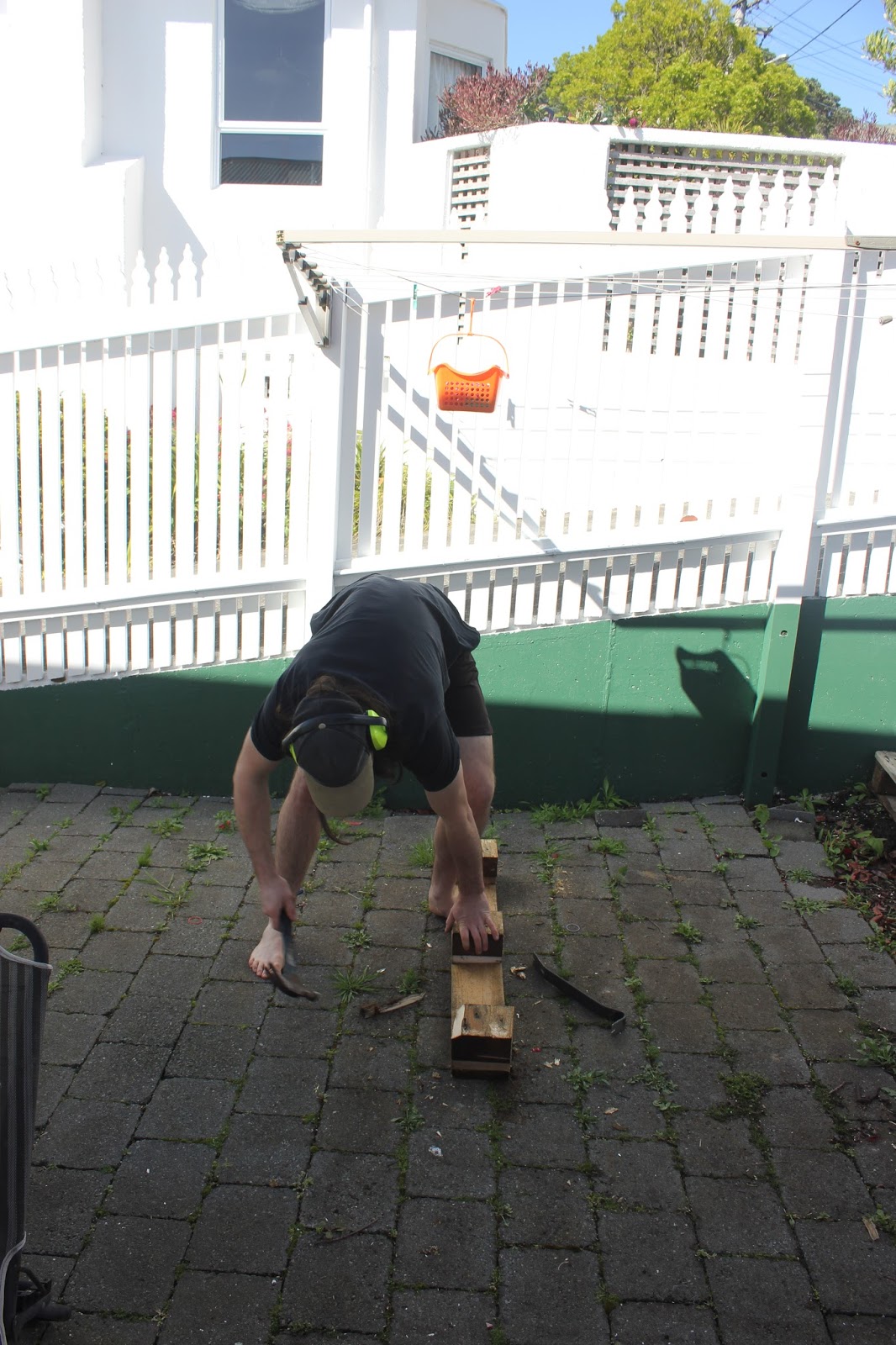
I had a simple design for a box in my mind and between us we brought it to life, we each wielded a hammer and got to work creating the box.
Wood slats on the bottom
Seeing as we were to put our new garden straight onto the lawn I decided that putting a bottom on it would contain the soil and plants in the box and also keep weeds from outside of the box from getting in.
Salvaging wood from old pallet scraps.
We didn't have quite enough pieces of timber the right length to cover the entire bottom so I had to deconstruct some other pieces of pallets I had around to get all of the pieces needed.
The bottom covered
Giving the box the bottom not only acts as a container for the soil and plants, but also gives the rest of the box strength, by pulling it all together.
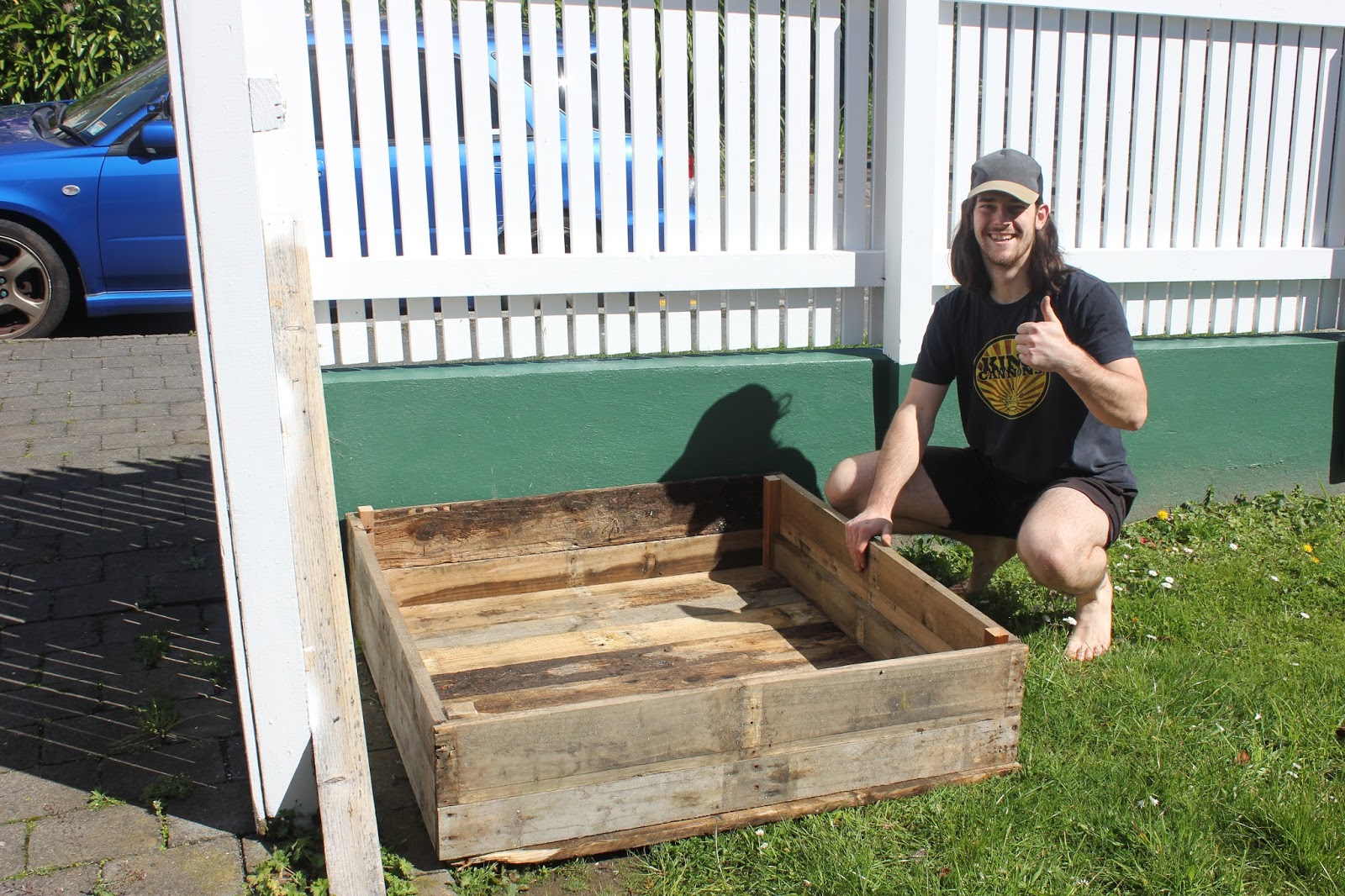
Our finished box
The morning's job was over, we had completed the box construction, after lunch we would get to planting some veggies.
The garden box in its final resting position, unobtrusive and situated for morning sunshine.
We have been flatting in Wadestown at the forge, for the better part of this year, and have consistently been adding to a compost bin that was here on the property when we moved in. Over the course of six months we have been adding our food scraps and grass clippings to the compost bin and given a mix every now and then. The result of six months of being fed and breaking down, is beautiful soft soil that can now be used for our garden, hopefully to yield a good bunch of vegetables (at least enough for a salad).
The black compost bin stays out of the way
Inside is a mix of soft soil and the plant matter that will break down into it.
It took a few trips of carting buckets back and forth from the compost bin to our garden in order to fill it up. It also became hard to dig the soil out from the bin, fortunately these compost bins do not have a bottom so they can be pulled up and over from around the soil, this made things a lot easier.
The box filled with soil and divided into 9 equal sections.
By dividing the garden into sections we made it easier to keep track of the plants we will plant, one square for each species.
Constructing a frame for bean vines to climb
We had purchased some bean plants which grow in the form of a vine, in order for these to grow properly we had to construct a frame which could then have string hanging from it.
Stringing the frame so the plants can climb up
We planted a bunch of different plants including beans, tomatoes, carrots, capsicum, cucumber, lettuce, and also marigolds. The marigolds are said to repel moths and other insects; hopefully this means that when our vegetables grow they will not be eaten by bugs but be in tact for when we want to eat them.
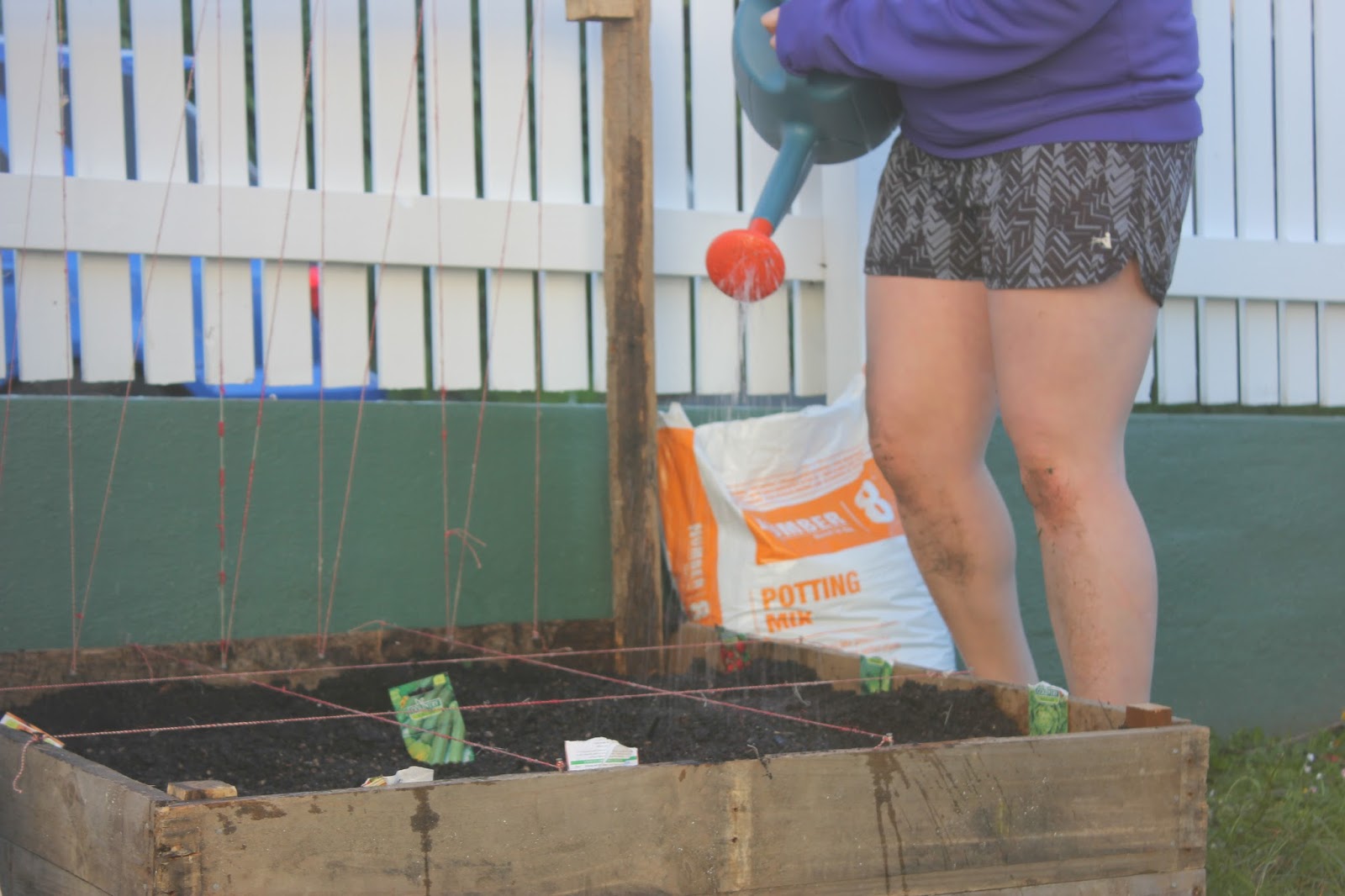
Watering our plants for the first time.
We watered all of our plants for the first time, something we will continue to do, especially on hot summer days. Watering is best done at dawn and dusk, when it is the right temperature to allow the plants to absorb the water without the sun evaporating it.
Gardener Jayden: American Gothic impression
And of course, the best way to celebrate a job well done is by posing in a few silly photos. Behind these two silly poses I was sincerely stoked with what we had accomplished in a day. It is about time I starting taking part in gardening, something I think is so central to sustainable living.
Gardener Jayden: Rocking out with a rake.
Gardening is a fantastic hobby to have. It requires hard work, care, and patience. Just like hunting and farming it allows people to appreciate where their food comes from. Through consistent care of your garden you will reap the benefits of nutritious food to sustain your own body; you will also know exactly what has gone into the soil to create your food, it is your decision whether or not you use pesticides or fertilizers to enhance your plants growth (ideally not), I believe a garden needs good soil, plenty of sunlight and a little bit of water to encourage the best growth.
That's it.
Put simple things in to get the best things out. I hope. I'll tell you how it works out at the end of summer.
When it comes to spring cleaning and getting rid of all of the junk that you no longer use take a moment to consider where you might be able to send that stuff before concluding that it is rubbish doomed to a landfill. Also in your everyday dealings with waste consider these alternatives that are more environmentally friendly.
Getting started with the spring cleaning.
Appliances:
Old appliances when no longer useful or obsolete tend to take up space in a house. I still have an old Apple I-mac I am holding on to for no good reason. Some appliances still have value and it is easy to sell them on websites such as http://www.trademe.co.nz/ or in shops such as Cash Converters. If someone else can make use of it and you can profit from it then why not?
If that doesn't work you can try giving it away for free on websites such as https://nz.freecycle.org/. Here people give objects they don't want and take objects that other people no longer need. This website encourages re-purposing of everything from televisions and keyboards to glass jars and microphone stands.
Apple Imac. Taking up space and not being used.
Household items:
Anything intact and not electronic can generally be gifted to a second hand store, clothing, furniture, household goods, toys and books.
One of Wellington's many Op-shops. http://www.vinnies-wellington.org.nz/wp-content/uploads/2015/01/Khandallah-Shop-Outside-2015-small.jpg
Clothing:
As well as the Op-shops listed above, there are some places that will take only clothing. Recycled clothing experts such as Rebound Clothing and SaveMart will take all clean clothing, even if it is ripped and useless.
Read here how SaveMart recycles through every step of their business:
Where does our stock come from?
It comes from various sources including:
1.Clothing Bin Contracts,
2.Recylcing Projects,
3.Woollen Mills,
4.Clothing Manufacturers,
5.Carpet Manufacturers,
6.Imports,
7.Surplus Stock,
8.Seconds and Opportunity Stores.
Hundreds of dedicated employees sort the incoming stock in to those items deemed suitable for sale in our stores, only the very best quality makes it onto the shop floor. It is value priced to sell in the same week. Unsold stock is removed after 4 weeks.
All wearable clothing etc that is unsuitable for sale in SaveMart stores is sent to Papua New Guinea where there is great need for clothing especially in the highland villages.
Inevitably there will be garments and material that are not able to be used again as originally intended, these can still be recycled as follows;
Cottons are made into Cleaning Rags, Knitted woollens and acrylic go to India to be made into blankets for relief organisations, Carpet yarn is used in the insulation industry.
Our aim is to recycle everything possible.
The inside of a SaveMart store, full of recycled clothing for sale. http://savemart.co.nz/images/SaveMart_New_Brighton_065.jpg
Clothing Bins can be found in most suburbs throughout Wellington. http://everydaysustainability.info/wp-content/uploads/2015/09/clothing-bin.jpg
As a person who always tries to make the most out of what I have got I tend to accumulate things, I'd like to differentiate between my thriftiness and being a hoarder because I try to use the things I accumulate. I have little containers filled with bits and bobs that I use from time to time. Here are a few examples of the stuff that I have that I hold onto for later use instead of throwing away.
Paper. Empty excercise books, blank paper, coloured paper, I have a pile of all sorts of paper that I can use whenever I need it. I use it to draw pictures, design my next project, scribble on, write lyrics or poems on, anything that I need blank paper for I have it sorted.
Shelf full of assorted leftover paper, to use when I have need.
Scraps of paper. I tend to accumulate scraps of life in the form of paper, whether this be ticket stubs, pictures, words, cards, post cards, photographs, or any number of other beautiful things; I tend to keep them. I have previously organized these onto cork boards, but more recently I have compiled them into a scrapbook. My scrapbook is a way for me to remember many scraps of time in a creative way, I glue all of the different pieces into the book, and then draw and write words around it; I empty my brain of all of the memories associated with that physical piece of my history.
A few open pages of my scrapbook.
Some of the images and physical memories within my scrapbook.
I have old notebooks intended for drawing in. I challenge myself to fill them up, here I get the most crazy images that come from my mind, they are for my eyes only unless I choose to share them, and I get to use the pen and paper in a way that nobody judges. I challenge you to find an old notebook around and to fill it up with ink in anyway that you can.
A Sneak peek from my weird doodling book.
Other Junk: I keep a lot of other junk hidden away for when I need it. I use old containers to store things in. Have a look at this older blog post about storage conatiners for some examples.
As you can tell I try hard to reuse as much stuff as I can, however I am realistic and know when something is at the end of its life and should be recycled or thrown away. The key part is really trying to make things last.
When something reaches the end of its life be sure to recycle it if possible, some plastics can be added to your weekly recycling collection, as can some metals; other metals will need to be recycled by taking them to a scrap dealer, if the metal is worth anything you will also receive payment for it.
As the sun begins to stay around a bit longer and you approach spring cleaning, be sure to minimize waste, re-use and recycle.
Between the 2nd and the 14th of January I dedicated myself to helping out at Venture Inferno. For those who don't know, a Venture is a 10 day camp for Venturers or 'older scouts' (14-18 yr olds).
The venture is split into two phases:
Phase One - five days when you go on an expedition of your own choosing,
Phase Two - five days on site at the main camp with a variety of activities on offer including a party each night.
Inferno was the theme of this years Venture. It was based in Rotorua, and offered a very action packed programme.
For Phase One I helped as a line leader, my job was to look after nine venturers. Our expedition of 80 people were set at Waitomo where we did three days of caving among other activities.
For Phase Two I offered my help at the hands on base, a marquee full of hands on activities ranging from making bracelets, decorating mugs, making nail wire art, and of course making Rat Traps.
We had a couple of piles of wood and a few rolls of steel mesh; some screws and staples; and some hammers and drills. The basis of the trap.
Someone had kindly setup some example traps showing the method of making it in four easy steps.
Step 1. Get first piece of wood, the base, staple one piece of mesh to it about 100mm from the front.
Step 2, Using the drill/driver screw the base piece to the two other pieces of wood to create the boxes sides, staple the mesh to the two added sides.
Step 3, Get two wooden studs and screw them into the top corners of box to hold the trap in place.
Step 4, Cut a hole in one of the bottom corners of the mesh. Cover both ends of the box with more mesh. cut a hole in the front mesh in the opposite bottom corner.
Done.
It took a little bit of time to make my first trap, but as I continued, the process got faster and faster. More people joined and I was able to teach, observe, learn, and adapt my methods. I found that cutting the mesh was the hardest, most tiresome part, so I would work at that so the venturers could get on with the more fun construction part. The mesh was also quite sharp so when handling it you had to take care. It was encouraged that any sharp ends be cut off so that when using the trap the person doesn't cut themselves. We also learned to use any left over bits of mesh too to make the most of the resources that we had.
On the third day Didymo Dave came to help out, he was the one who organized the supplies and would be using the traps to control pests on the Waitahanui River. As well as refining the trap making process he also educated us on the traps and their use. Although we call them rat traps the traps would be used for not only rats, but also ferrets, weasels, and stoats. all rodents that kill our native birds for food or just for fun. The traps are made with the holes cut in the mesh on opposite corners to prevent kiwi from getting its beak inside and snapped off in a trap.
Didymo Dave also encouraged us to write a message on our box to the pests that would be caught within. One creative venturer wrote 'Dear Rodents, Gluttony is a deadly sin'.
Over the course of four days I have gone from not knowing how to build a rat trap to not only building around twenty of them, but teaching others how to make them, empowering people who usually wouldn't give something like this ago, and allowing them to do it themselves and leave feeling that they have made a positive contribution to the native bird life of New Zealand.
Below is a link to Didymo Dave's facebook page, here you can find out more about the pest control along the Waitahanui River. Rat Traps made with Didymo Dave
I live in rural Wellington with my partner Shellie, together for the past few years we have relied upon driving a car that has been loaned to us, a red Mitsubishi Lancer. One morning a couple months back we were driving to work through the busy morning traffic; it was a cold winters morning, the windows were foggy from condensation, and there was blinding sun strike hindering our safe progression to the city; ultimately this led to us being rear ended by a little old lady who was also blinded by the sun.
The Lancer
Upon closer inspection, our car got written off, the result of a bent chassis. The insurance money was paid to the owners of the car, and we were left without a vehicle.
Some of you may know I live in an area of Wellington where public transport is not an option. We needed a vehicle as soon as possible to continue going about our daily lives. We ended up buying two vehicles over two weekends.
The old scooter, it putted out and got sold for parts
Perhaps you are to the view point that the use of petrol is killing our world and anyone using a vehicle unnecessarily is kicking their boot in at mother earth. I know that my use of petrol is killing the earth, but I believe that our use of two vehicles is the most suitable mode of transport for our lifestyle.
The first vehicle we purchased is a yellow Honda Fit, the Japanese equivalent of the Honda Jazz. This 'Small Car' "Fits" our needs nicely. Although smaller than the Lancer, it has a lot of storage space, it carries up to 5 people, perfect for driving friends and family around and holding a weeks worth of gear whilst we are away from home. Also, the Fit is more fuel efficient than the Lancer, we save $10 every time we fill it up.
The Fit
For the first week we made use of the fit for all of our needs, but we soon found we each wanted to be self sufficient as far as transportation. The following weekend we purchased a Motorized Scooter; a PGO, PMX Naked 50. I originally wanted to get a motorbike but being sensible we agreed to buy something that both of us could drive.
Our new PMX
In purchasing the two vehicles we exchanged money intended as our international travel fund, into two vehicles, two assets, and in doing so, cemented our residence as being in New Zealand for the next year or so.
Shellie was thrilled with owning our own car; this meant that she could get from one place to another and have the ability to work her jobs as a nanny for two different families, being able to drive children from A to B.
I am thrilled to have the scooter because it means not having to rely on the car; being able to drive through rush hour traffic slightly faster; and most conveniently, being able to park right outside my work building in the middle of the city all day for free.
Two of my least favourite things are getting stuck in traffic and paying for petrol. In a different world I would not have to face either of these daily realities, but instead I live a life that requires my mobility. With my lifestyle the choice of vehicles that I drive complement the way I go about my daily business.
By driving a car I feel obliged to take into consideration fuel efficiency. Our current car is more fuel and money efficient than the Lancer, and the costs of driving the scooter are almost negligible; I am often taken aback by the fact that I can pay for a weeks worth of petrol for the scooter out of the few coins in my wallet.
I used to stress about having to pay money all the time just for it to turn from Liquid petrol into fumes that become lost to the air; the reality is though, that purchasing petrol has become routine. Whenever the car is empty it gets filled up. I know that this is an extremely privileged situation, but our income from working the lifestyle that we have chosen does allow for our transport costs to be covered.
I still do worry about my fuel consumption, If I lived anywhere else I would happily use public transport or even travel by bicycle. The reality is that having two vehicles opens up so many opportunities for us, yet it retains out desired lifestyle. Firstly we live in Makara, the rural part of Wellington. This place is inspiring, rugged, and beautiful. Living here has enhanced my ability to perform well as a designer and a photographer, it has encouraged my creative output, and ultimately it has promoted my emotional well-being and a happy state of mind, I wouldn't trade all of that in for a cheaper transport option.
Using the train system in Wellington is very efficient.
Vehicles allow Shellie and I to do the things we love, this includes our ability to attend scouting activities. Without a vehicle we would be unable to turn up and be scout leaders for the twenty or so children from the Karori West Scout troop, we would be depriving them of learning life skills and bush craft. We would be unable to attend Rover Scout events, depriving ourselves opportunities of self-development. Personal transport allows me to see my parents most weekends, therefore strengthening our relationship. As an adventurous couple, Shellie and I like to explore the country. Our vehicles allow for this, whether it is a road trip on State Highway 1 in our car, or a afternoon adventure with the two of us on the scooter, our appreciation of our country is made better by the use of our vehicles.
Not neglect for the environment, but passion for living. That is the reason we use machines that consume petrol and output bad emissions. The environmental impact still weighs on my mind, but not enough to change my choice of lifestyle, not yet.
This week I am lifting content straight from my university work, Yesterday I handed in and presented my first project in the course 'Experimenting with materials'. The project focussed on taking a material and destroying it in order to make something new. Destructive Creation. We worked with physical techniques such as smashing, heating techniques such as melting, and chemical techniques such as rusting. Read on for more.
Heres what Interested me about this project:
Over the course of my university life I have been able to define myself as a designer by what interests me and what I think is important. The two things that this comes down to are
1: D.I.Y., The culture that surrounds it, the practice of doing it, and all of the benefits that go along with that.
2: Sustainability, creating in a sustainable way that does not impact the earth negatively, whether this be recycling old materials, making the most of green spaces, or any number of other things.
Our second lecture of this course was inspiring to say the least. As soon as I saw the calm waves seen of the video below I knew I was watching something special. It contains all things that I love, DIY, Sustainability, Film, Fire, Re-use, and beautiful scenery to name a few.
I'll try not to get too poetic about my feelings towards this video, but I thought two things after watching this video for the first time. 1. Why aren't more people doing this, and 2. I have to do this.
After a small internet search I found a couple of lo-fi, videos showing that people already are doing this on an amateur level.
See the videos here for a gow to turn old plastic into a new and beautiful slingshot.
Needless to say it was my turn to have a go.
I started with a walk on my local beach in Makara.
My girlfriend Shellie and I walked the beach for 40 minutes filling our buckets to the top. There were bottle caps and plastic rope, and all other plastic crap you can think of.
Back at home this is our haul.
Before I could use it it needed to be sorted and washed.
Here is your daily dose of disturbing images.
As seen here, plastic discarded from people everyday that gets washed down rivers and out into the ocean gets mistaken for food by birds such as the three species of endangered albatross (There are a further 19 species of threatened albatross).
In an ideal world everyone would go out into the ocean, or down to the beach, fish out some old plastic, and use that instead of making more new stuff.
I want to work further in the area of plastic recycling, below are some of my experiments.
My first experiment was indoors on a kitchen element. The plastic melted to the extent that it was maleable but still identifiable, this created a vibrantly coloured bottle top pancake.
From this point on I opted for outdoor cooking. Using an open fireplace would give me a more intense heat, and being outside meant I wouldn't need to worry about getting bad smells throughout the house. My second attempt created a large creen/grey sheet, solid, yet able to be cut into pieces.
My next piece comprised two seperate cooks merged together, the first was perfect, using colourful plastic ropes. The second was awful, it burnt and turned to charcoal, I had used a rubbish grade of plastic. However, I was still able to chop and drill into the block.
Now I would focus my experiments a little more.
My first focussed experiment. Melting milk bottles into a goo I poured it into a cubic mould. Once cooled and removed from the mould it was scalded on the outside, once sanded away it unveiled the light coloured marbling seen here.
The next experiment was melted to extreme heats to the point that the plastic turned to liquid. The molten plsatic was poured into a mould and after bubbling, cracking and eventually setting and cooling I took to it with a band saw, exposing these brilliant marbling patterns.
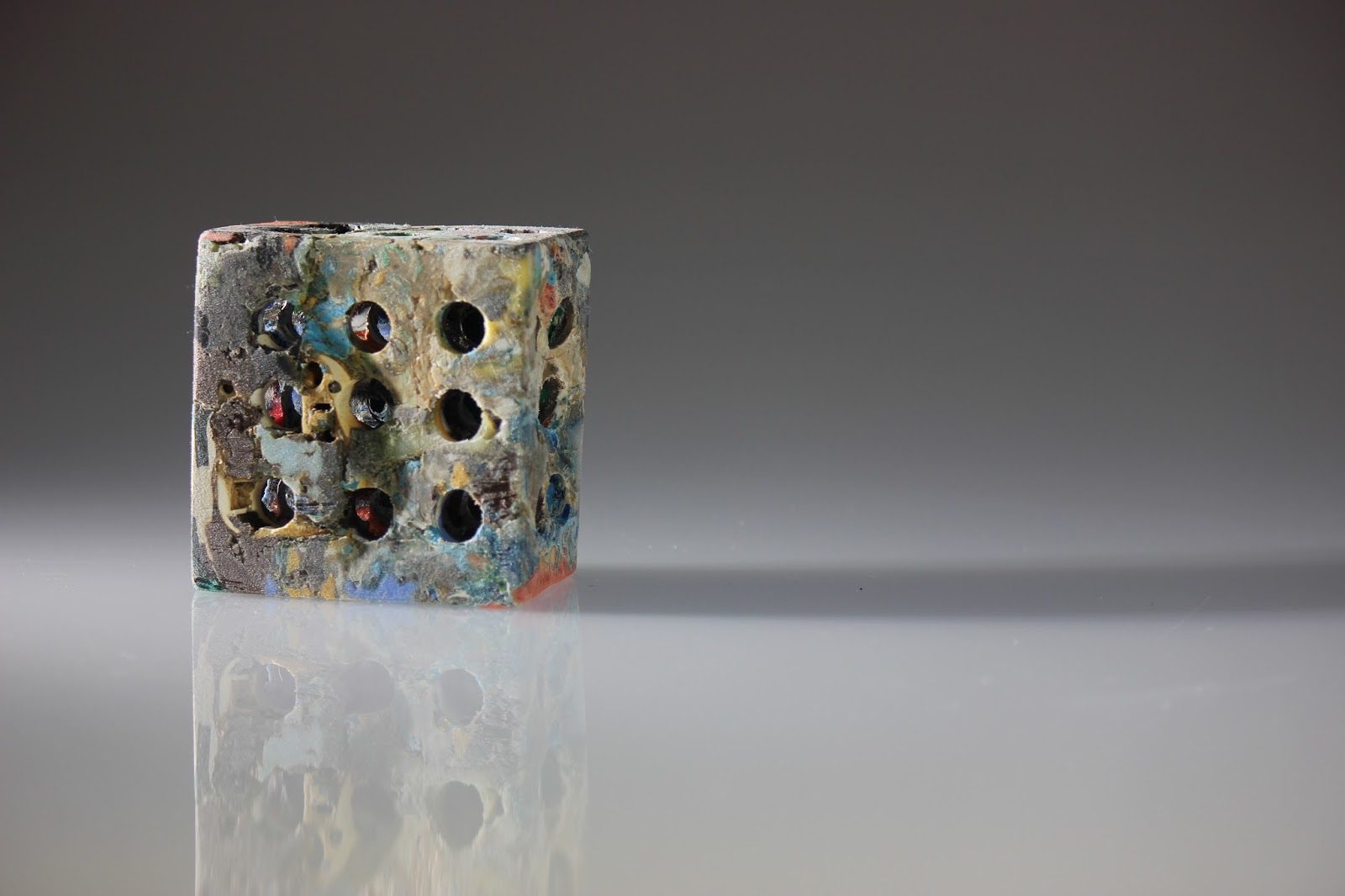
My final experiment had colour. Vibrant colours that I wanted to bring out and expose. By drilling through it I exposed the colours hidden in the center.
Although it does just look like a block with holes in it, that isn't the point. The point is that by creating your own plastic mould you can create anything. Any shape that you can come up with has the potential to be made out of the rubbish found on the beach.
It's easy. It's simple. It's plain reckless not to do it. Taking your own re-useable bags to your local countdown, new world, pak n' save or wherever else you buy groceries. I'd like to say this has become the norm. It hasn't. The majority of people still turn up to the supermarket once a week without their own bags and in turn put another 20 plastic bags into our local landfill weekly.
The energy to create a re-usable bag is estimated to be equivalent to the energy to create 28 plastic bags. Therefore to have any environmental impact you need to use your re-usable bag 28 times, is that right? Wrong. If you can use your own old fabric to create shopping bags out of, then each time you use your bag you are stopping another plastic bag from being used. Fantastic. Making you own bags is easy. Use some old fabric, sew a couple of seams up, and voila you have a bag that you can use and use and use again.
Wine in a homemade bag, made from an old couch throw.
A lot of people seem to think that bringing their own bag is a hassle and not worth the effort. The reality is, If everyone used their own bags instead of plastic we would be producing far less waste than we currently do. Leave your bags in the car, and use them again each time you shop.
If I just sound like a random blogger whining about plastic bags, watch the video below and then see if you are swayed.
As Tim Minchin says "Do something drastic to rid the world of plastic". On a side note, I'd also like to discourage the purchase of fruit and veg that is wrapped in styro-foam and plastic. Is there anything more unnatural that we could do to disguise the things we consume?
I know that sometimes it is hard to refuse a plastic bag, and sometimes your things are bagged before you have a chance to refuse; in situations like these, it isn't worth the hassle to make a scene and draw unwanted attention to yourself. Instead, take the bag, but use it. Make sure its life is one of use.
Don't just bin it, there are heaps of things plastic bags can be used for, it can store your loose belongings, like jigsaw pieces, or lego. It can be used to store fruit, or used as a means of battering your potatoes and other veg in tasty herbs and spices. And of course, it can house other pieces of rubbish, I admit it, I still bin things, what else do I do with all of that belly-button fluff? An old plastic bag can still do good if it contains other objects that are inevitably headed toward the landfill.
Plastic bag as a rubbish liner, to contain all other waste.
If you have read my manifesto you'll know that I am an advocate for buying good stuff. Believe it or not plastic can be good stuff. Using lunchbox quality plastics can be more beneficial to the environment than using cheap plastics that will crack, shatter, and be thrown away.
At chinese fast-food outlets the plastic that your chow mein comes in is rubbish. One use and it is bust; but lunchbox plastics bought at any supermarket could last more than a decade with the right care.
Good re-useable lunchbox, containing porridge for breakfast.
I have recently been suggested the idea that instead of using plastics from a chinese fast food store, or even the plastic at supermarket pick n mix, I should instead take my own containers and keep on re-using those.
A decent plastic container can be used for many things. I use them to hold my lunch, to store foods, and objects around the house, and recently for even more sustainable food shopping. Of course they are only a great tool so long as they do not break; a lot of love must go into all items, even plastics to ensure that they survive a long time.
As my birthday is approaching in less than a month I have naturally thought of a few gift ideas. One of the items on my wish list is a guitar pick cutter which cuts old credit-cards into guitar picks. Brilliant way to give a piece of plastic some new life. Especially seeing as I am always losing picks. This nifty item will save on pick costs, enable some creative license when deciding on my pick colouring, and breathe new life into the many expired credit cards which nowadays people chow through.
http://www.pickmaster.co.uk/
Lastly this week I am to talk about something somewhat disappointing to a Wellingtonian like myself. The Wellington Hurricanes were favourites to beat the Otago Highlanders in the Rugby Super 15 final. As I am not the gambling man the extent of my wager was that the winning team decided the beer that would fill my next crate. The bottles that make up a crate are a brilliant example of re-use that is not only environmentally sustainable, but also economically friendly. The first time you buy a crate of beer you pay an extra 5 dollars for your crate and bottles, every other time after that you are saving money by swapping the bottles in. These bottles in turn just get sterilized and then refilled with beer. As my team lost my next refill will be a southerners drink. Speights.