My fiance Shellie has an incredible passion for her job as an early childhood teacher, her area of expertise is the outdoors and how children interact with outdoor spaces.
She had an idea of creating a big barrel swing, and sourced a big blue barrel as a starting point.
Once brought home to the forge we took it into the workshop dungeon to carve with the Jigsaw. First we took one of the ends off, this created a space where the children could crawl into. We then cut a window into one of the curved edges of the barrel. This window allows the children to hang their legs out of the barrel, to see out of the barrel, or even climb through into the barrel, and allowed the children to create the swinging motion by pushing against the ground..
Shellie cutting the front window out of the swing.
The next step was to drill four holes into what would be the top of the swing, rope will be tied through these holes so it can be hung securely at the Early Childhood Centre.
We also drilled a couple of holes in the bottom for the purpose of drainage.
Once we were happy with the shape of the swing we had to soften the edges. We scraped off as much of the rough plasctic shards as we could and then tried to sand the edges which clogged the paper, the next trick we tried was melting the edges so they were flat; we used a small blowtorch and guided the flame across the plastic edges this worked well.
Once at the Centre we used rope to suspend the swing. Using knots that would not slip or come undone we tied the barrel to hooks which were screwed into the platform above.
The swing in place at the centre.
The general reaction from the children at the centre was excitement at the new interactive piece of playground equipment,
This week I am lifting content straight from my university work, Yesterday I handed in and presented my first project in the course 'Experimenting with materials'. The project focussed on taking a material and destroying it in order to make something new. Destructive Creation. We worked with physical techniques such as smashing, heating techniques such as melting, and chemical techniques such as rusting. Read on for more.
Heres what Interested me about this project:
Over the course of my university life I have been able to define myself as a designer by what interests me and what I think is important. The two things that this comes down to are
1: D.I.Y., The culture that surrounds it, the practice of doing it, and all of the benefits that go along with that.
2: Sustainability, creating in a sustainable way that does not impact the earth negatively, whether this be recycling old materials, making the most of green spaces, or any number of other things.
Our second lecture of this course was inspiring to say the least. As soon as I saw the calm waves seen of the video below I knew I was watching something special. It contains all things that I love, DIY, Sustainability, Film, Fire, Re-use, and beautiful scenery to name a few.
I'll try not to get too poetic about my feelings towards this video, but I thought two things after watching this video for the first time. 1. Why aren't more people doing this, and 2. I have to do this.
After a small internet search I found a couple of lo-fi, videos showing that people already are doing this on an amateur level.
See the videos here for a gow to turn old plastic into a new and beautiful slingshot.
Needless to say it was my turn to have a go.
I started with a walk on my local beach in Makara.
My girlfriend Shellie and I walked the beach for 40 minutes filling our buckets to the top. There were bottle caps and plastic rope, and all other plastic crap you can think of.
Back at home this is our haul.
Before I could use it it needed to be sorted and washed.
Here is your daily dose of disturbing images.
As seen here, plastic discarded from people everyday that gets washed down rivers and out into the ocean gets mistaken for food by birds such as the three species of endangered albatross (There are a further 19 species of threatened albatross).
In an ideal world everyone would go out into the ocean, or down to the beach, fish out some old plastic, and use that instead of making more new stuff.
I want to work further in the area of plastic recycling, below are some of my experiments.
My first experiment was indoors on a kitchen element. The plastic melted to the extent that it was maleable but still identifiable, this created a vibrantly coloured bottle top pancake.
From this point on I opted for outdoor cooking. Using an open fireplace would give me a more intense heat, and being outside meant I wouldn't need to worry about getting bad smells throughout the house. My second attempt created a large creen/grey sheet, solid, yet able to be cut into pieces.
My next piece comprised two seperate cooks merged together, the first was perfect, using colourful plastic ropes. The second was awful, it burnt and turned to charcoal, I had used a rubbish grade of plastic. However, I was still able to chop and drill into the block.
Now I would focus my experiments a little more.
My first focussed experiment. Melting milk bottles into a goo I poured it into a cubic mould. Once cooled and removed from the mould it was scalded on the outside, once sanded away it unveiled the light coloured marbling seen here.
The next experiment was melted to extreme heats to the point that the plastic turned to liquid. The molten plsatic was poured into a mould and after bubbling, cracking and eventually setting and cooling I took to it with a band saw, exposing these brilliant marbling patterns.
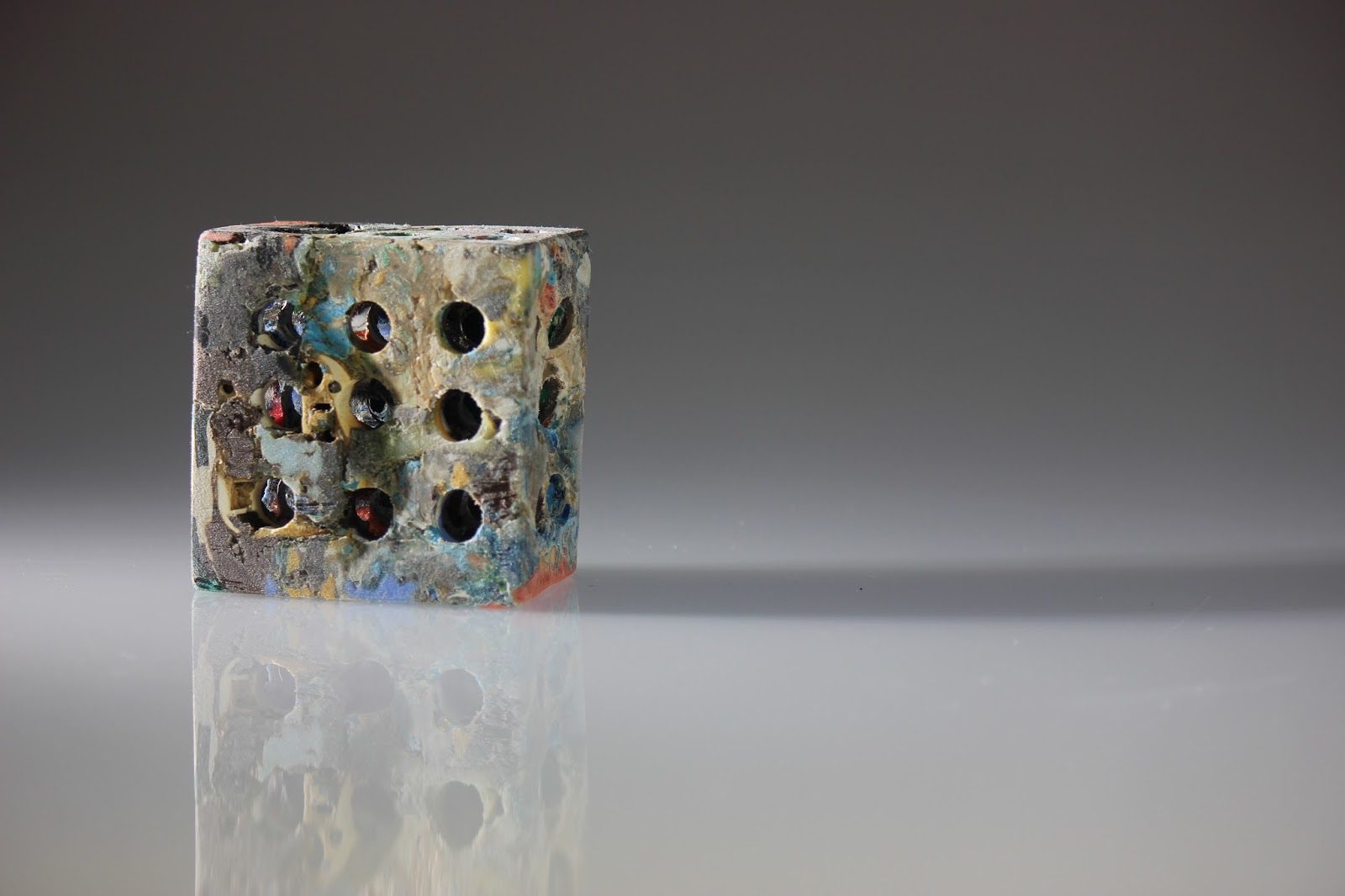
My final experiment had colour. Vibrant colours that I wanted to bring out and expose. By drilling through it I exposed the colours hidden in the center.
Although it does just look like a block with holes in it, that isn't the point. The point is that by creating your own plastic mould you can create anything. Any shape that you can come up with has the potential to be made out of the rubbish found on the beach.
First of all. I'm sorry its late, this week has been a week of illness and stress and I am only beginning to put the rest of it in order.
Pressing on.
Wellington is a great place to live because on both Saturday and Sunday every week there are veggie markets. I often use the Victoria Street market on a Sunday which is run out of trucks in a car-park block. Another brilliant veggie market is the Hutt City Riverside Car-park market, held every Saturday, this market is similar, but also includes some fast food stalls and other junk stores, and some other types of goods.. Generally they are open all morning until the steady stream of customers dissolve in the early afternoon
The best thing about shopping regularly at the veggie market is that it is cheaper. I won't start crunching numbers here, but your $20 on veggies will make you a lot more stir fry if you spend it at the market than at some super-brand-company that will sell you food that is sub-par for the price you pay. The best thing is saving money, but it isn't the only thing.
By shopping at the market you as a buyer are saying no to the overpriced veg, no to the imported veg, and no to the veg that has been frozen six months ago, only to be defrosted and put on shelves when it is no longer grown, that is given to you from supermarkets. There is no need to purchase fruit and vegetables that are individually wrapped in plastic. When you shop at the market you show your power as a buyer by negating the advertising and signposting of corporate super chains, and choosing for yourself instead, good locally produced food. Simple. You 'Take the power' and 'share the power'. Choosing your own destination for your hard earned coin.
By clicking on the above link and signing your name, you will be helping to rid supermarkets of excess plastic as seen in the image above.
Market shopping is good for the soul.
The setup is only present one morning per week and therefore a lot of people rush to one place to buy their vegetables. You will be pushing, squeezing, and excusing your way past many complete strangers, and that is good. You learn skills of interaction not only with them, but also with the tellers.
You are outside, rather than in a warehouse prison that the media has hypnotized you into spending much of your life in. You will experience the weather, you will breathe fresh clean air, and you will have to avoid mess on the ground that no one will cleanup. Market shopping will keep you active, and fill you with your daily dose of fresh air.
Market shopping at first can be an overwhelming experience, but when you have learnt to move with the crowds and handle your goods it becomes a fun experience. You will get to know your food better by moving around it and exploring good and less good qualities of food. You will have opportunities to eat and taste your food, One of the best marketplace snacks is vegetarian dumplings. Often times the market will have a busker or two, making music for the people to enjoy, some people love buskers and give them a few spare coins, others despise their attempts to screech out well known lyrics; regardless, buskers add to the environment of humanity found at the market. There are people. Lots of people, you might see a friend you know.
Holding on to many bags of food as well as operate the mechanism of a wallet and the correct coins can be tricky, but in a fast paced market environment you will learn how to make a transaction fast. Some tips:
1. Take a friend. They can help you hold stuff, while you take on wallet responsibilities.
2. Prepare your money before approaching the teller, and move off to the side once the transaction is complete. This is an efficient way of market shopping that saves you time, and allows those waiting in line behind you to get on with their transaction.
Market shopping works perfectly with re-useable bags, just weigh and pay for your produce and then put it in your own bag. A decent big bag will save on awkward carrying, and lessen the impact of your consumerism on the environment.
Recently I have even purchased free range eggs from the market, these are at similar prices to your normal Farmer Brown caged eggs from Countdown Eggs. Now that leaves your conscience feeling clean.
Clean your fruit and veg
Speaking of clean, you must be vigilant at the market to choose produce that isn't spoiled. Check for clean fruit and veg before you buy. A cheaper price at the market means a product with less life, the cheapest bananas will be ripened black in a couple of days so you will have to use them quickly. Clean your veg when you get home. Some people suggest cleaning produce before you eat it, I suggest cleaning it before you put it away; by doing this you ensure that the produce is not rotten, you can maximize spacial efficiency by cutting up certain produce and throwing out (composting) the waste;
Capsicums are a great example. Cheap to buy in bulk; when I get home with them I chop them up, chop the top, the bottom, cut out the seeds and core, and cut the stem off the top piece, you will be left with the top, the bottom, and a large round. Rinse these in water, shake off any excess water, and then put them in the fridge in a container, ready to use when you need them.
A whole capsicum chopped, cleaned, and ready to eat.
By buying from the market and looking after your food before you eat it, you will be eating the best healthiest food there is on offer. If you run into me at the market, come and say hi!
It's easy. It's simple. It's plain reckless not to do it. Taking your own re-useable bags to your local countdown, new world, pak n' save or wherever else you buy groceries. I'd like to say this has become the norm. It hasn't. The majority of people still turn up to the supermarket once a week without their own bags and in turn put another 20 plastic bags into our local landfill weekly.
The energy to create a re-usable bag is estimated to be equivalent to the energy to create 28 plastic bags. Therefore to have any environmental impact you need to use your re-usable bag 28 times, is that right? Wrong. If you can use your own old fabric to create shopping bags out of, then each time you use your bag you are stopping another plastic bag from being used. Fantastic. Making you own bags is easy. Use some old fabric, sew a couple of seams up, and voila you have a bag that you can use and use and use again.
Wine in a homemade bag, made from an old couch throw.
A lot of people seem to think that bringing their own bag is a hassle and not worth the effort. The reality is, If everyone used their own bags instead of plastic we would be producing far less waste than we currently do. Leave your bags in the car, and use them again each time you shop.
If I just sound like a random blogger whining about plastic bags, watch the video below and then see if you are swayed.
As Tim Minchin says "Do something drastic to rid the world of plastic". On a side note, I'd also like to discourage the purchase of fruit and veg that is wrapped in styro-foam and plastic. Is there anything more unnatural that we could do to disguise the things we consume?
I know that sometimes it is hard to refuse a plastic bag, and sometimes your things are bagged before you have a chance to refuse; in situations like these, it isn't worth the hassle to make a scene and draw unwanted attention to yourself. Instead, take the bag, but use it. Make sure its life is one of use.
Don't just bin it, there are heaps of things plastic bags can be used for, it can store your loose belongings, like jigsaw pieces, or lego. It can be used to store fruit, or used as a means of battering your potatoes and other veg in tasty herbs and spices. And of course, it can house other pieces of rubbish, I admit it, I still bin things, what else do I do with all of that belly-button fluff? An old plastic bag can still do good if it contains other objects that are inevitably headed toward the landfill.
Plastic bag as a rubbish liner, to contain all other waste.
If you have read my manifesto you'll know that I am an advocate for buying good stuff. Believe it or not plastic can be good stuff. Using lunchbox quality plastics can be more beneficial to the environment than using cheap plastics that will crack, shatter, and be thrown away.
At chinese fast-food outlets the plastic that your chow mein comes in is rubbish. One use and it is bust; but lunchbox plastics bought at any supermarket could last more than a decade with the right care.
Good re-useable lunchbox, containing porridge for breakfast.
I have recently been suggested the idea that instead of using plastics from a chinese fast food store, or even the plastic at supermarket pick n mix, I should instead take my own containers and keep on re-using those.
A decent plastic container can be used for many things. I use them to hold my lunch, to store foods, and objects around the house, and recently for even more sustainable food shopping. Of course they are only a great tool so long as they do not break; a lot of love must go into all items, even plastics to ensure that they survive a long time.
As my birthday is approaching in less than a month I have naturally thought of a few gift ideas. One of the items on my wish list is a guitar pick cutter which cuts old credit-cards into guitar picks. Brilliant way to give a piece of plastic some new life. Especially seeing as I am always losing picks. This nifty item will save on pick costs, enable some creative license when deciding on my pick colouring, and breathe new life into the many expired credit cards which nowadays people chow through.
http://www.pickmaster.co.uk/
Lastly this week I am to talk about something somewhat disappointing to a Wellingtonian like myself. The Wellington Hurricanes were favourites to beat the Otago Highlanders in the Rugby Super 15 final. As I am not the gambling man the extent of my wager was that the winning team decided the beer that would fill my next crate. The bottles that make up a crate are a brilliant example of re-use that is not only environmentally sustainable, but also economically friendly. The first time you buy a crate of beer you pay an extra 5 dollars for your crate and bottles, every other time after that you are saving money by swapping the bottles in. These bottles in turn just get sterilized and then refilled with beer. As my team lost my next refill will be a southerners drink. Speights.